I wanted to write on the the verse Hebrews 7:25 today because it can answer many questions regarding salvation.
Hebrews 7:25 reads “Consequently, he is able to save to the uttermost those who draw near to God through him, since he always lives to make intercession for them.”
This scripture is talking about Jesus, and speaks of the wonderful fact that he is the unique Savior of the world. God knows every need we will ever have, and this states he is able to save (people) to the uttermost. The scripture is speaking about those who draw near to God through Him (Jesus).
What did the writer of Hebrews intend with the choice of the word uttermost? If we look up the original meaning of the word uttermost in the early Greek manuscript, the word is uttermost is taken from the word “pantelés”. Panteles means “all; full-ended; entire; completion”. See https://biblehub.com/greek/3838.htm
This truth is definitely an encouragement to those who are wondering if God is enough. Or for those who question how deep God’s work of salvation is, he saves people to the uttermost. This covers every base, every personal weakness, every type of position people are in now and in the future and even those who feel like they don’t know if they can bring what is required “to the table”. The truth is the scripture says salvation comes to people not because they bring their righteousness to the table, because God (and Jesus) have already “set the table” so to speak as far as what is required for salvation.
Salvation in God’s plan for the world to be saved, required nothing less than Jesus’ perfect life of obedience and sacrificial love. It has already been paid in full by Jesus’ giving his perfect life to God as an offering for my account and your account. This is God’s great news to us!
God intends to grant people the wisdom in their saving relationship with Him to learn His ways. This wisdom unfolds in the lives of God’s people as a natural part of God the Father being a good father to us. The believer simply should remain open to God, by reading his word. God is able to teach us and train us in living a life of faith. We should simply talk to our Heavenly Father as a real person, as the one who is able to meet every need. Through dwelling with God in faith, going to him with our questions, our concerns, our thanks, as we keep trusting him to guide us and provide for us, our faith can grow, and we can find we are getting to know our Father God and Jesus as the graceful people they are. God’s plan of salvation for you is a good one. Are you willing to let today be the day you put your roots of faith in God for his salvation? He is able to save us to the uttermost. LG
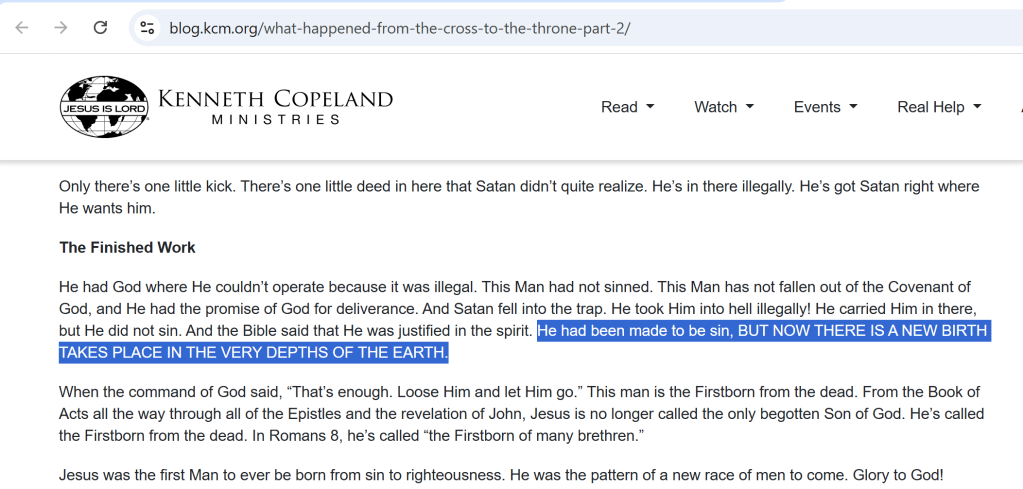
I am writing this article to show plainly that Kenneth Copeland on his website is teaching the idea that Jesus was born again in hell, and the ridiculousness of this idea, and why this idea is a false teaching, and Copeland’s misunderstanding of Jesus’s authority.
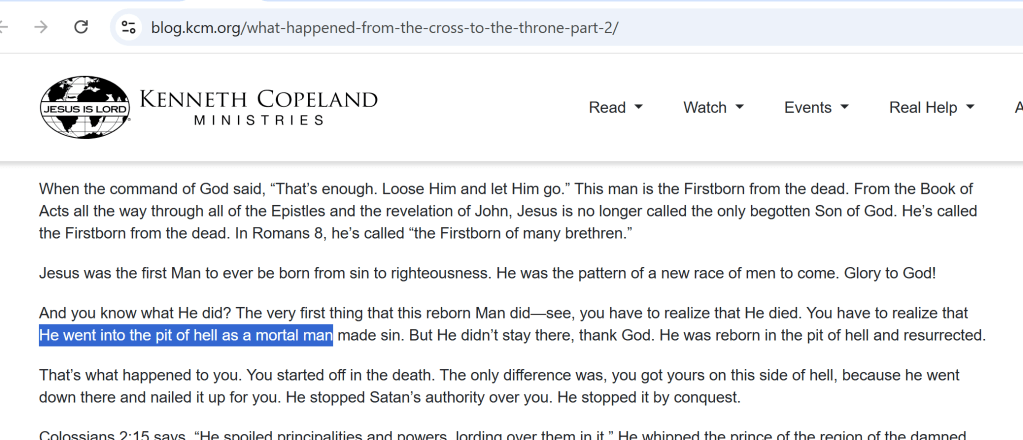
I am basing this blog post on Kenneth Copeland’s online article entitled “What Happened From The Cross To The Throne Part 2” I will share screenshots to document the false teachings in his article. This screenshot below was taken near the heading entitled “The Finished Work”. Note the highlighted areas:
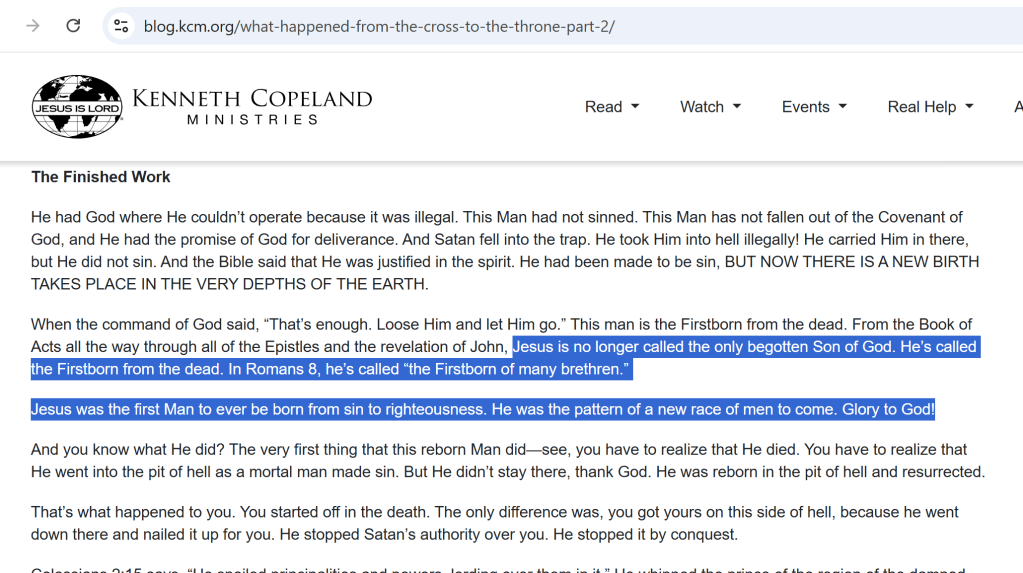
Copeland above says that Jesus went to hell and was born again there. This is absurd because being born again was something God provided as a rescue for mortal sinners who need forgiveness, that would give them new spiritual life with God. Jesus was never a sinner and he did not need to be forgiven, and he already had spiritual life with God. Jesus did not need the kind of salvation that God provided as a ransom for sinners. Jesus WAS the ransom. Jesus IS salvation. Let’s look at the next highlighted area in the screenshot below.
Copeland says Jesus is no longer called the only begotten Son of God from the book of Acts to John’s Revelation, but He’s called the Firstborn from the dead. Copelands definition of these two phrases are very different that what the Bible teaches. Copeland seems to say “Jesus was born again, and that he needed to be born again in order to be the leader of all Christians who need to be born again, so he could be the Firstborn of many brethren.” But the logic doesn’t follow. A Shepherd doesn’t have to become a sheep to lead the way for the sheep to be saved from danger. A Shepherd just leads them and is way above them in many ways, such as knowledge, common sense, ability and strength. A shepherd doesn’t have to eat grass to show his sheep how to keep from starving. Again the shepherd is way above the sheep but Jesus made the sheep to be drawn to eat when he created them. Jesus saves us not by being born-again himself, but by drawing us to believe in him and be saved. He stays way above us and doesn’t need to be born again to be the Firstborn of many brethren. Because He is GOD.
But Copeland says that the meaning of Jesus being begotten means Jesus was born again, but what it means Biblically is that there was only ONE conception like the conception of Jesus. That was when the Holy Spirit overshadowed Mary and God placed physical DNA inside of Mary, the physical material that would become Jesus’s body, and God placed the Soul and Spirit of Jesus in union with his body so that he would grow up in Mary’s womb. and become the God-man, God from God, Light from Light. Because believers in Jesus are “born from the dead”, Copeland conflates this in his thinking to mean Jesus and born again people are on the same playing field. The Bible teaches believers are born-again, from a place of deadness to God, and made alive to God, but we are not “God from God, Light from Light” as Jesus was. The believer retains many of his or her personality traits and cognitive and physical abilities after he or she becomes born again as they had before they were born again. We don’t give up our personalities to become saved. We are made in the image of God, but retain many of our traits, but what is new, is that we receive the spiritual fruit of Galatians 5, and other communicable attributes of Jesus, but we are not on the same playing field as Jesus in his incommunicable attributes. We are saved from the bondage to sin, and delivered out of the kingdom of darkness, where now Jesus is our new King in the Kingdom of Light. Jesus is way HIGH above us. But Copeland is demoting Jesus and making him as common as a born again person:
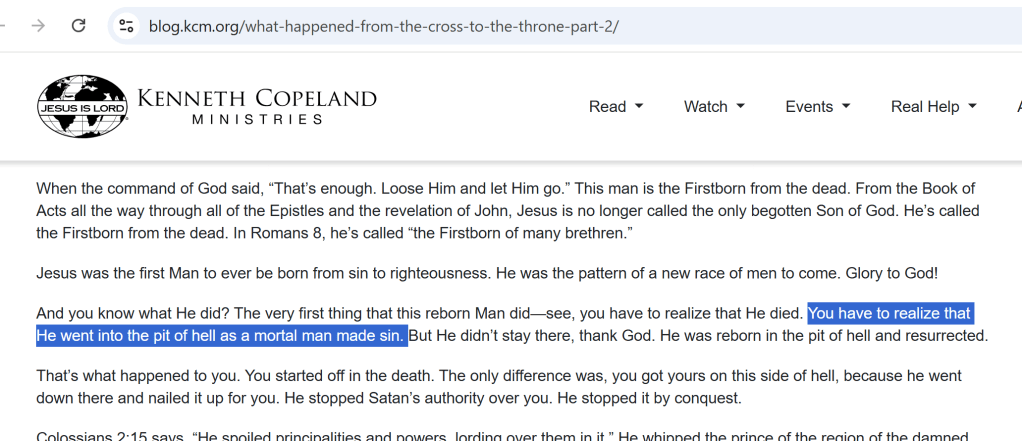
and again:
He said Jesus was just a mortal man made sin. But Jesus was the God-man, not JUST a man. The phrase Jesus “was made to be sin”, many scholars believe that it is the short way of saying Jesus became the sin offering, and that Jews of Jesus’ time would shorten the phrase “the sin offering” to “sin”. So if we plug that phrase into 2 Corinthians 5:21, it would say “For our sake he made him to be (the) sin (offering) who knew no sin, so that in him we might become the righteousness of God.” ESV parentheses mine.
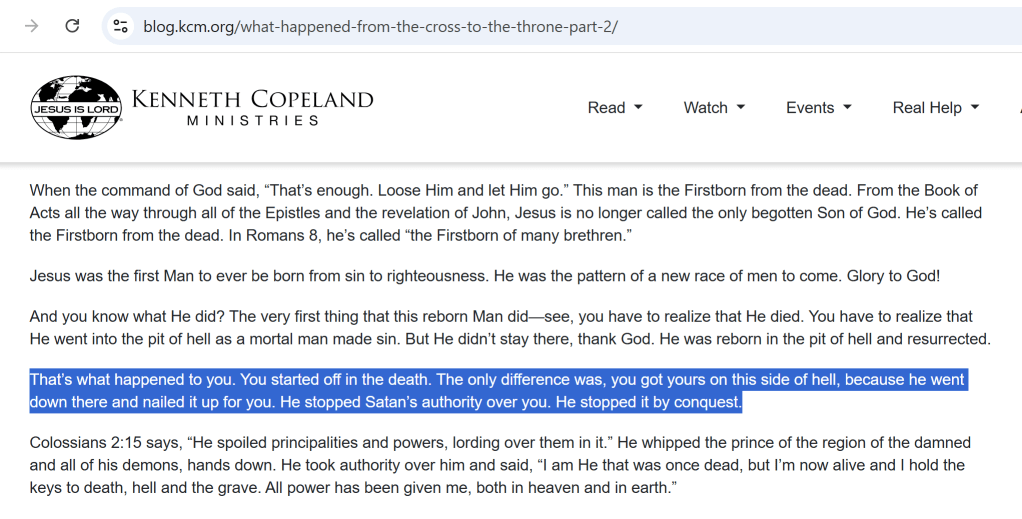
Copeland believes there are similarities between Jesus’s resurrection and the believer’s resurrection. The Bible does too. But Copeland makes up similarities between the believer and Jesus that don’t exist. Note the words below, “…the only difference…”:
When Copeland says “the only difference was, you got yours on this side of hell” I believe he is talking about the resurrection. The believers were raised up from spiritual death when they are born again on this side of heaven. True, but Copeland’s statement that Jesus went to the very pit of hell and “nailed it up for you. He stopped Satan’s authority over you. He stopped it by conquest” has tremendous problems. Copeland is talking about a conquest in hell between Satan and Jesus that we can safely say Copeland imagined, because it is no were in the Bible. In the Bible Jesus paid our sin debt in full on the cross, and then he said “it is finished” before he died. Jesus was awarded resurrection because the full wrath of God had been exhausted upon him and paid for. The righteous wrath of God had been poured out on Jesus and was satisfied, so, there was no punishment for Jesus left nor for those who would believe upon Him for him to have to go to the very PIT of hell. After Jesus died, he could go to paradise and lead captivity captive specifically because of the victory of the cross. This was the place of Abraham’s bosom. This was the place where the righteous saints who died before the resurrection of Jesus would go. So there was no conquest between Jesus and Satan in the PIT of hell.
The pit of hell would be a place of suffering and torment for those punished by God. God was the one who punished Jesus in our place on the cross. Jesus didn’t go as someone’s prisoner when he died, because “death could not hold him”, and Satan by that point was defeated, so he didn’t go to the pit of hell, but to Abraham’s bosom, or Sheol to lead captivity captive. And when he went and took captivity captive, he certainly wasn’t kept in the pit of hell by Satan, or by God but Jesus had full authority over himself after he died because he had full authority over himself while he lived each day of his life. He never gave Satan a foothold. Satan had no hold on him, and the very pit of Hell was only for those who live in sin and refuse to follow God. Jesus was successful in paying for our sins before he died. He said “It is finished, then breathed his last.” Copeland has nullified the power of the Cross:
The conquest Jesus won, was on the cross, by humbling himself, dying in our place, and taking our sins upon himself and bearing them away as the sinless lamb of God. There was no conquest between Jesus and Satan after he died because while he was on the earth, there was no physical conquest between Jesus and Satan on the earth. Satan also couldn’t lie to Jesus and be successful. Jesus just spoke the truth and resisted Satan. And Satan fled. When Jesus was crucified it was God’s plan to save the lost. Here is the victory Jesus had on earth in never sinning. Jesus’s authority over himself was in tact all the time and that was how he won the conquest against Satan:
John 8:46: “Which of you convicts me of sin? And if I tell the truth, why do you not believe Me?” (NKJV).
2 Corinthians 5:21: “For He made Him who knew no sin to be sin for us, that we might become the righteousness of God in Him” (NKJV).
1 Peter 2:22: “Who committed no sin, nor was deceit found in His mouth” (NKJV).
1 John 3:5: “And you know that He was manifested to take away our sins, and in Him there is no sin” (NKJV).
Hebrews 4:15: “For we do not have a High Priest who cannot sympathize with our weaknesses, but was in all points tempted as we are, yet without sin” (NKJV).
In the shot above after the Colossians scripture Copeland writes that Jesus took authority over Satan and said “I am He that was once dead, but I’m now alive and I hold the keys to death, hell and the grave. All power has been given me, both in heaven and in earth.” Those are 2 scriptures from Revelation 1:18, and Matthew 28:18. But Revelation gives no proof or indication that this happened when Jesus was between the cross and the throne, nor that these scriptures were spoken one after the other, nor that Jesus spoke them to Satan. Rather, when the wrath of God was paid in full, and Jesus said it is finished, Jesus went to the place of the dead to cause several old testament saints to rise with him when he would rise from the dead. There is no evidence in the Bible that Jesus spoke to Satan between the cross and the throne. Rather, the evidence seems to point to the opposite because on the cross Jesus said “It is finished”, and these words signify that he spoiled the principalities and powers by the cross. Colossians 2:15 And having disarmed the powers and authorities, he made a public spectacle of them, triumphing over them by the cross.” The Devil was not in charge of anything anymore because the atonement was paid in full, and Jesus broke the power of death, hell, and the grave, but did this on the cross, not in hell.
Was it not the sheer righteousness Jesus offered, and shed blood and what he suffered on the cross with the full wrath of God being poured out on him in the atonement and those things together were indeed the fullness of all authority to clear the sinner of sin, when Jesus said the words “It is finished”? Those 3 words were spoken after the wrath of God was poured on him to signify to us no more atonement needed to be paid. Jesus had no need for a conquest or words with the devil–the atonement was God’s business, not the devil’s, and the resurrection was God’s business demonstrating Jesus’s full authority was unstained, in tact and I believe unchallenged between the cross and the throne. *LG
Salvation does not require repentance, but it produces repentance.
According to Wayne Grudem, in his book Systematic Theology, An Introduction to Biblical Doctrine, on page 699 we find him explaining that regeneration happens before conversion happens (conversion defined by faith and repentance). Regeneration is a work done completely by God, and initiated by God. Faith and repentance come usually hand in hand, and repentance and faith are enabled to happen by God and somehow allowing our participation, causing us to be willing to use our faith and willing to repent, and prompting us toward these actions.
We could ask, “How simple can salvation be and it still counts as salvation?” A person’s salvation could be as simple as was the salvation of the thief on the cross, who lived just minutes or hours in a state of salvation.
Romans 10:13 reads, “for, “Everyone who calls on the name of the Lord will be saved.”
This is quite simple. But is it simply repeating something out of your mouth? Is it that all God is requiring is that we should repeat a phrase amounting to “Save me Lord Jesus” like a robot and that’s all that would be needed to save someone? Surely Romans 10:13 means more than mouthing a prayer like a robot to appease God.
The Bible makes reference to the idea that what goes on in the heart is paramount to what matters to God in the process of prayer or in the process of saving someone. I am not saying that we need to make the act of calling on God more difficult than it needs to be, but I am saying calling on the name of the Lord in the Biblical sense should mean at least to be sincere in your calling on the name of the Lord.
We could imagine a child who cries crocodile tears to avoid punishment after getting caught doing something wrong. We can imagine a person who simply says words to a beautiful woman with a hope to “say what she wants to hear” simply in order to manipulate her. Or we could imagine a person who pretends to like a food coked a certain way in a meal not because he genuinely liked it but simply to humor the chef to stay on his good side.
How does the Bible mention the need for sincerity in praying for salvation?
Psalm 145:18 The Lord is near to all who call on Him, To all who call on Him in truth. 19 He will fulfill the desire of those who fear Him; He will also hear their cry for help and save them.
It says if you call on Him in truth, the Lord is near you. If we look up Romans 10:13 in the Greek, on Biblehub.com, it says the phrase “shall call upon” has some interesting traits. About halfway down the page of https://biblehub.com/greek/1941.htm in the lexicon section we get this explanation:
“5. Hebraistically (like יְהוָה בְּשֵׁם קָרָא to call upon by pronouncing the name of Jehovah, Genesis 4:26; Genesis 12:8; 2 Kings 5:11, etc.; cf. Gesenius, Thesaurus, p. 1231{b} (or his Hebrew Lexicon, under the word קָרָא); an expression finding its explanation in the fact that prayers addressed to God ordinarily began with an invocation of the divine name: Psalm 3:2; Psalm 6:2; Psalm 7:2, etc.) ἐπικαλοῦμαι τό ὄνομα τοῦ κυρίου, I call upon (on my behalf) the name of the Lord, i. e. to invoke, adore, worship, the Lord, i. e. Christ: Acts 2:21 (from Joel 2:32 ()); ; Romans 10:13; 1 Corinthians 1:2…”
Near the end of the quote we get the words, “I call upon (on my behalf) the name of the Lord, i. e. to invoke, adore, worship, the Lord…Romans 10:13.” This is saying the way calling on the Lord happens in Romans 10:13 involves invocation, adoration, or worship of the Lord. So when this calling on the name of the Lord happens, intrinsic within the calling, is a directional repentance that is distinguishable from a prior direction of sin, because in order to invoke, adore or worship the Lord, one must have turned or at least be in the process of turning from sin in order for that calling on the name of the Lord to be sincere, which is the root meaning of Romans 10:13.
Now if you are sincerely calling on the Name of the Lord, you must have some understanding that the Lord is higher and more powerful than you are, to save you, and the result is, if you are sincere, you shall be saved.
It may be hard to distinguish from the Bible what millisecond a repentance happens after faith is operating. But I think it is right to understand that calling on the Lord in truth as Psalm 145:18 also seems to intrinsically to involve a turning from sin or evil, which is repentance in its initial stage. We realize that in ourselves we have no power to save ourselves, and in turning to God, if we are going to seek him in a truthful way, we can believe he is in the opposite direction from our sin, or from the evil we find ourselves stuck in at times, and by calling on him the very act of turning to the Lord is in fact a turning from sin and evil, (repentance) although a beginning repentance, but the Bible says that is in fact sufficient to save someone. (Romans 10:13) After justification happens for the believer, the Lord continues the work of salvation through refining us with more repentance and the sanctification process. LG
The truth is all of us have sinned. We’ve all fallen short of the glory of God. (Romans 3:23)
I don’t mean God isn’t interested in our obedience, because He is! (Romans 1:5) But He must save us first before we can have the kind of obedience he is looking for! (2 Timothy 1:9, Galatians 3:6-9) When God begins with us, we deserve God’s wrath for eternity because it’s about who we’ve sinned against. Why is sin so serious? –because of who we’ve sinned against. The greater the person to whom a wrong is done, the greater the wrong that is done. It’s ultimately against God that we’ve sinned. Every sin we commit is against God in the least sense and against two or more persons in the broadest sense.
God cannot and does not need our efforts to save us because Jesus said it is finished. (John 19:30) It would go against God’s aseity if salvation were dependent on us, (Psalm 3:8) and if it’s against His aseity, it’s against his nature. (Isaiah 45:5, Psalm 86:10) And it would go against what Jesus said if it were not finished but was dependent on us. And that would make Jesus a liar, and he is not! That would make him not Lord but he is Lord! (1 Corinthians 8:6, John 20:28)
If he needed us to do part of the work of our own salvation, and we sometimes err, that means I will or could potentially mess up if it were dependent on me, because erring is the very reason we need salvation. (Romans 3:23) And if my salvation depended on myself, and not God, that potential for error could or would somehow get translated into the work of salvation in my life IF the work of salvation was somehow my work. (Ecclesiastes 7:20, John 3:19) But it’s NOT, it’s God’s work in spite of our work, (Isaiah 57:18) it’s God’s work in place of our work, (Genesis 15:12-21) his work in times of us bewildered because of our failure, (Job 42:6) it’s God’s work in exchange for our work, (2 Corinthians 5:21) it’s God’s work because we don’t have the capacity to work it out left to ourselves, (Romans 5:6) it’s God’s work and him taking the initiative because He sees our work is broken.(Genesis 3:21) It’s God working and us resting in him, Him doing and us trusting, because his work is everlasting (Jeremiah 31:3, Isaiah 41:28) and even when we feel frozen, (Psalm 46:10) or pausing because of our loud weaknesses, (Matthew 26:75) it’s God’s strength made perfect in our weakness (2 Corinthians 12:9).
The act of him making us born again is his work 100%. (Isaiah 43:11, Hosea 13:4) That saves us from having to produce the work of making us holy. He will make us holy and he’ll do it by using our obedience (Leviticus 20:8) but not because he is short on obedience but uses ours to shape us. (2 Corinthians 3:18, Romans 8:29). So He is totally in control of the work of saving and sanctifying us. He began the good work and He will finish it.(Philippians 1:6) He is the author and perfector of our faith. (Hebrews 12:2) He is the birther of our walk of service to God, (Exodus 23:25) the designer of it, the upholder of our salvation, (Isaiah 41:13) the producer of it, (1 John 5:4-12) the continuer or it (John 8:31-32) and the founder and completer (Hebrews 11:10, 12:25-29) of the life given by God (1 Corinthians 3:11)
It has to be his work, or it cannot be pure; (2 Samuel 22:7, Habakkuk 1:13) it must be his work or it’s not trustworthy; (Psalm13:5, Isaiah 26:3-4) his work (Revelation 7:10) or it’s not genuine from start to finish. (1 Peter 1:7) And there is only one type of thing from us he needs and that is our failures and sins, our errors and impurities, our falling short and our inadequacies, our blotches and our messes, our missing the mark, and our misunderstandings. Then it’s real! (Colossians 2:14, Galatians 3:14) LG